
If you are currently sourcing or specifying backshells, it is highly likely you are working with an existing manufacturer’s part number. Start with your commercial and technical intent: you need a reliable, high-performance component that drops seamlessly into your existing system architecture without requiring an extensive redesign.
EMCA manufactures high-performance backshells and connector accessories that are fully compatible with many industry-standard connector systems. Existing part numbers from manufacturers like Glenair, Polamco, and others can frequently be matched to an identical or superior EMCA equivalent.
Ready to find your match? If you already have a part number and want an immediate cross-reference, use our Equivalent Parts Finder Tool to instantly check for equivalent EMCA components.
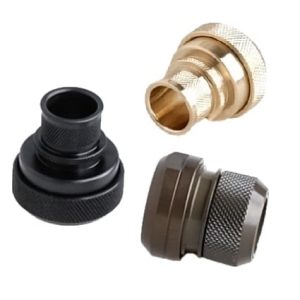
At EMCA, our engineering expertise ensures that "equivalence" goes far beyond a basic form-factor match. To guarantee true interchangeability in harsh environments and mission-critical applications, an equivalent backshell must precisely match a rigorous set of engineering parameters.
When evaluating or designing an equivalent solution, we ensure conformity across nine distinct criteria:
Deciphering backshell part numbers can feel like decoding a complex puzzle. Although different manufacturers utilize proprietary numbering systems, most military-specification (MIL-spec) and VG-qualified backshell part numbers describe the exact same underlying engineering characteristics.
To visualize this, consider this simplified, conceptual breakdown of how a backshell part number communicates its anatomy:
ABC-15-90-ZN-16
| Element | Meaning | Description |
|---|---|---|
| ABC | Product Family | Defines the design style (e.g., Banding adapter, Strain relief) |
| 15 | Connector Shell Size | Specifies the matching connector size designation |
| 90 | Routing Angle | Indicates a right-angle backshell configuration |
| ZN | Material & Finish | Denotes Black Zinc-Nickel plating over aluminum |
| 16 | Cable Entry Size | Defines the maximum diameter of the entering cable bundle |
In reality, actual manufacturer numbering schemes are significantly more complex and may require expert cross-referencing.
Navigating the regulatory landscape of interconnect accessories reveals distinct standards. Competitors rarely explain the nuance between these codes, but understanding them is key to effective procurement:
Because multiple numbers can originate from different standards bodies or commercial catalogs, technically identical products frequently wear entirely different part numbers. An EMCA engineer can map these disparate standards back to a single, high-performing equivalent.
If you compare a Glenair part number alongside a Polamco part number for what is functionally the exact same backshell, they will look entirely different. This variance is largely historical and commercial, driven by proprietary cataloging systems.
However, beneath the surface, both manufacturers encode the exact same core engineering DNA:
Because both systems are trying to communicate the same physical realities, EMCA can easily bridge the gap. We translate these competing numbering logics into our own high-quality, equivalent configurations without sacrificing performance.
The following table illustrates how common commercial backshell series from existing manufacturers map directly to EMCA equivalent product lines.
| Existing Manufacturer | Example Series | EMCA Equivalent Series |
|---|---|---|
| Glenair | 440A Series | EMCA A3 Series |
| Glenair | 440H Series | EMCA A3 Series |
| Polamco | 91A Series | EMCA A3 Series |
| Polamco | 91H Series | EMCA A3 Series |
| Polamco | BT-A Series | EMCA A3 Series |
Note: This is a brief representation. EMCA supports thousands of direct cross-references matching standard, micro-miniature, and heavy-duty backshell variants.
In the interconnect industry, a standard part number shouldn't come with a 20- to 40-week waiting period. While larger manufacturers frequently force you into lengthy backorder queues, EMCA operates with a different supply chain philosophy.
We maintain an active, physical inventory of core backshell configurations right here on our shelves.
Don't wait months for an alternative. Browse our In-Stock Backshell Range right now to see what's ready to ship today.
Yes. EMCA designs and manufactures backshells to meet or exceed the performance parameters of industry-standard commercial parts, including those from Glenair. Our components feature matching interfaces, threads, materials, and finishes, making them direct form, fit, and function replacements.
The part numbers themselves follow different alphanumeric codes, but the physical products they represent are fully interchangeable. By matching the interface, shell size, entry size, and plating, an EMCA part will seamlessly replace a Polamco part within your assembly.
Our online search tool features a built-in pattern recognition engine designed to handle this. If you input a part number with specific hardware modifiers—such as Glenair option codes or Polamco spring (-HE) and band (-SB) references—the engine automatically isolates the core backshell family to find your match.
Note: If your project strictly requires those specific accessories, our interface will flag it and prompt you to contact our sales team so we can configure the exact matching hardware for you.
Absolutely. This is built directly into our search tool's logic. If you search for a legacy competitor part number that uses a non-compliant finish (like Cadmium), our system automatically calculates the equivalent part number using our premium EMCA Black Hybrid Finish (Code J). You can update your Bill of Materials to a fully compliant, modern standard with a single click.
If a competitor part number isn't available, we can build an equivalent from scratch. We just need to know:
The mating connector series (e.g., MIL-DTL-38999 Series III)
The required cable routing angle (Straight, 45°, or 90°)
The exterior diameter of your cable bundle, or backshell cable entry size
Your material and environmental sealing requirements

